 English
 中文简体

Pre Cut Baking Paper Sheets are made from wood pulp and coated on both sides with a food-safe silicone layer. This coating gives the paper a smooth, greaseproof, and moisture-resistant surface that su...
See DetailsHow Do You Match Pre Cut Baking Paper Sheets to Pans
A baker lines a brownie pan with a piece cut from a roll, and the paper curls up halfway through pouring the batter. A cake pan gets a sheet that is slightly too wide, and the edge folds into the sponge. Small fit problems like these slow down preparation and affect how cleanly food comes out. Pre Cut Baking Paper Sheets remove the repeated measuring and trimming, provided the dimensions match the pan. Choosing the right size comes down to three things: the real interior dimensions of the pan, how much edge coverage the recipe needs, and the shape of the bakeware.
Why Does Paper Size Matter?
Baking paper forms a protective layer between food and the pan surface. A sheet that is too small leaves patches of bare metal. A sheet that is too large folds into the batter or bunches at the corners, which can leave marks on the underside of the bake.
Lining needs vary by recipe:
- Cookies need coverage across the flat surface.
- Brownies often benefit from paper that extends over two sides for lifting.
- Cakes may need a bottom piece plus separate side strips.
- Loaf breads work well with paper that runs along the long walls.
Pre-cut sheets are especially handy for home bakers who use the same trays every week, and for small baking businesses that prepare several batches a day with identical pans.
How Should the Inside of a Pan Be Measured?
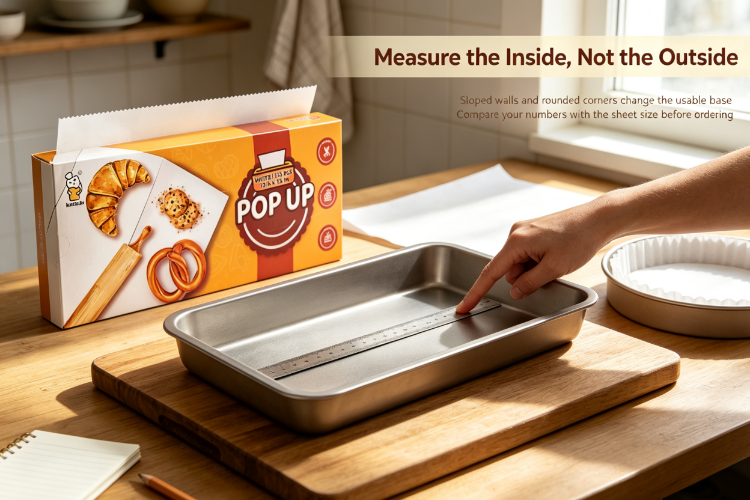
The size stamped on a pan or the outside measurement does not always match the usable base. Sloped walls, rounded corners, and wide rims make the opening larger than the bottom.
Rectangular and Square Pans
Place the empty pan on a flat surface, then measure the inside bottom length and width with a ruler. Note whether the corners are rounded or sharp, and compare the numbers with the sheet size on the packaging. If the recipe calls for side coverage, also consider the pan depth.
Round Pans
Measure across the flat bottom through the center. The upper rim may be wider than the base, so it is a poor reference. For deep cake pans, a circle covers the base while strips line the wall.
| Pan Feature | What to Check | Why It Matters |
|---|---|---|
| Rounded corners | Interior corner shape | Reduces paper bunching |
| Sloped sides | Bottom and opening dimensions | Avoids wrong size assumptions |
| Deep walls | Interior depth | Decides side coverage |
| Flat base | Usable bottom area | Guides bottom sheet choice |
Which Sheet Shape Suits Which Pan?
Rectangular trays serve cookies, brownies, roasted vegetables, and tray bakes. Choose a sheet that covers the base, and allow extra material only where the recipe needs paper up the sides. Oversized sheets create uneven layers under the food.
Square pans need attention at all four corners when paper rises up the walls. For brownies, a sheet that overhangs two opposite sides gives lifting handles once the bake has cooled.
Round cake pans work well with circular sheets, which avoid corner folds. Compare the sheet diameter with the actual interior base. Side lining usually needs separate strips.
Specialty molds such as loaf pans, muffin trays, and decorative molds call for different handling.
| Bakeware | Suggested Paper | Lining Consideration |
|---|---|---|
| Cookie tray | Rectangle | Cover the flat surface |
| Brownie pan | Square or rectangle | Consider lifting edges |
| Round cake pan | Circle | Check bottom diameter |
| Loaf pan | Rectangle or custom cut | Account for depth and long sides |
| Muffin tray | Individual liners | Match each cavity |
| Decorative mold | Custom-shaped paper | Check the actual contact area |
How Much Edge Coverage Is Needed?
Flat trays for cookies and crackers usually need bottom-only coverage. The sheet should lie flat without hanging far past the edge, and it is easy to swap between batches.
Side coverage helps with soft or structured bakes. Brownies benefit from lifting edges, cakes from a lined base with side strips, and loaves from paper along the long walls. Flat cookies rarely need full side lining. When a recipe states a lining method, follow it.
Loose paper shifts when batter or dough goes in, and extra material can fold into the food. A few habits help:
- Choose a sheet that matches the coverage you need.
- Press the paper gently against the flat base.
- Fold corners neatly where side coverage is required.
- Use a food-safe method to hold paper in place while preparing.
- Keep loose paper away from heating elements.
Lightweight paper should never sit unsecured in an empty oven. Follow the manufacturer's temperature and handling guidance.
How Are Different Pans Lined?
Rectangular Pan
Confirm the inside bottom measurements, lay the sheet over the base, fold corners if side coverage is needed, and smooth out creases before adding food. For brownies, let the paper extend over two opposite sides.
Round Cake Pan
Confirm the bottom diameter, place the circle inside, check that its edge sits within the base, add side strips if the recipe asks for them, and smooth the base before pouring the mixture.
Loaf Pans and Deep Molds
Food rises along the walls, so a long rectangle covering the base and the long sides works well, with extensions left for lifting where the pan allows. In decorative molds, do not force a flat sheet into complex shapes. Use a suitable format or individual pieces.
Keeping Paper Stable
A small amount of batter can hold the paper to the base before the rest goes in, if the recipe allows. On dry trays, make sure the paper lies flat before arranging cookies.
What Mistakes Are Common?
- Measuring the outside of the pan instead of the interior base.
- Ignoring depth, since bottom coverage and full lining need different arrangements.
- Assuming every round pan shares one base diameter.
- Buying sheets that are too small and leave bare areas.
- Using oversized sheets without adjustment.
- Forcing standard rectangles into unusual molds.
- Forgetting how the bake will be removed.
A quick measurement check before buying reduces waste and repeated adjustments.
Should You Choose Sheets or Rolls?
Recipe videos and small home bakeries have made efficient preparation more appealing. The choice often depends on how many different pans a kitchen uses.
Sheets arrive ready to use, with consistent dimensions, less preparation, simple storage, and no need for scissors. They suit people who repeat favorite recipes in familiar pans. Rolls offer flexible sizing for kitchens with varied or unusual pans, though every use requires measuring, cutting, and checking the fit.
| Consideration | Pre-Cut Sheets | Rolls |
|---|---|---|
| Preparation | Ready to use | Requires cutting |
| Dimensions | Consistent within the pack | User decides |
| Repeated recipes | Convenient for matching pans | Repeated preparation |
| Unusual pans | May need another format | Flexible cutting |
| Storage | Individual sheets | Roll form |
What Should Be Checked Before Buying?
Dimensions and Shape
Compare the listed length, width, or diameter with your measured pans, and check whether the pack contains rectangles, squares, or circles. Different bakeware may call for more than one format.
Material and Oven Suitability
Review material information, the stated temperature limit, food-contact suitability, intended uses, and storage guidance. Heat resistance and coating differ between products.
Routine Fit
A cookie-focused baker may prefer rectangles, while a cake baker may also need circles. Small bakeries benefit from consistent formats across repeated batches.
How Can Bakers Find the Right Fit?
Each pan has its own dimensions and each recipe its own lining needs. Measuring the interior base, deciding on edge coverage, and choosing a suitable shape make everyday baking easier to organize. Bakers who want to compare available sizes and shapes with their own pans are welcome to explore our range of Pre Cut Baking Paper Sheets and check the listed dimensions and product instructions before ordering.
Related Products
-
-
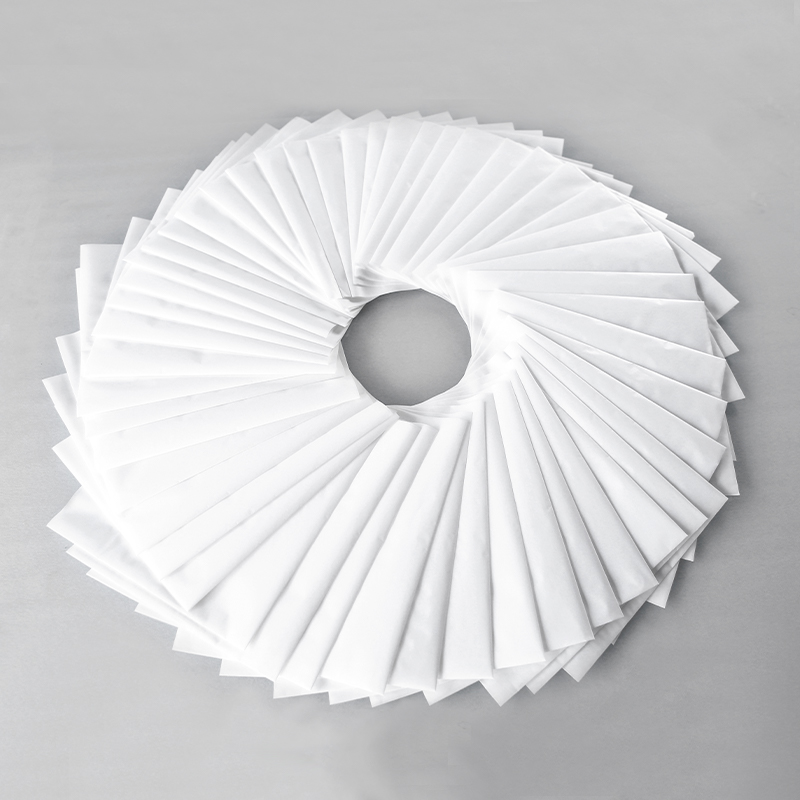
Folded Baking Paper Sheets, also known as Non Stick Baking Paper Sheets, are made from wood pulp and coated on both sides with a food-safe silicone layer. This coating gives the paper a smooth, grease...
See Details -
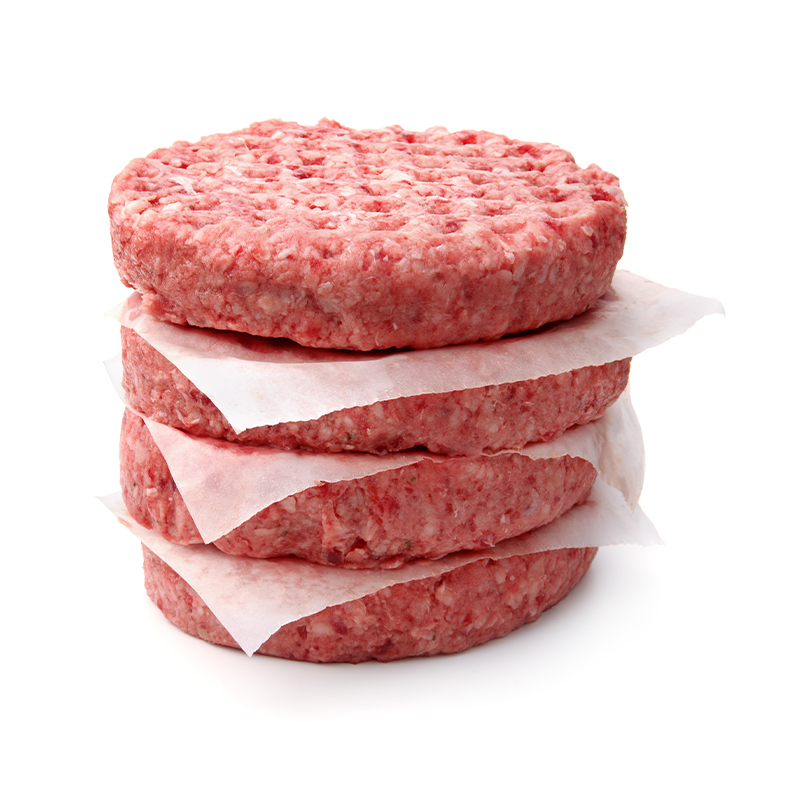
Description: Wax paper is the paper that is coated with food-grade wax in order to make it non-stick and waterproof. wax paper is very good for food storing and presentingMade of food-grade paper and ...
See Details -
Product Features: 1. Virgin wood pulp 2. Double sides food grade silicone-treated 3. Fluorine-free 4. Non-stick 5. Oven/Microwave safe 6. Freezer safe 7. Reusable 8. BPA f...
See Details -
Product Features: 1. Virgin wood pulp 2. Natural unbleached brown color 3. Double sides food grade silicone-treated 4. Fluorine-free 5. Non-stick 6. Oven/Microwave safe 7. Fre...
See Details -
Product Features: 1. Virgin wood pulp 2. Double sides food grade silicone treated 3. Fluorine-free 4. Non-stick 5. Oven/Microwave safe 6. Freezer safe 7. Reusable 8. BPA ...
See Details -
Product Features: 1. Virgin wood pulp 2. Fluorine-free 3. BPA free 4. Biodegradable Product Details: In an era where environmental consciousness and sustainability are paramount, Natu...
See Details -
Product Features: 1. Virgin wood pulp 2. Double sides food grade silicone-treated 3. Fluorine-free 4. Non-stick 5. Air fryer basket safe 6. Reusable 7. BPA free 8. Biodeg...
See Details -
Product Features: 1. Virgin wood pulp 2. Natural unbleached brown color 3. Fluorine-free 4. BPA free 5. Biodegradable Product Details: Introducing our Unbleached Brown Food Grade ...
See Details -
Product Features: 1. Virgin wood pulp 2. Double sides food grade silicone treated 3. Fluorine-free 4. Non-stick 5. Steamer/air fryer basket safe 6. Reusable 7. BPA free 8...
See Details -
Product Features: 1. Virgin wood pulp 2. Double sides food grade silicone treated 3. Fluorine-free 4. Non-stick 5. Easy to separate 6. Reusable 7. BPA free 8. Biodegradab...
See Details -
Product Features 1. Virgin wood pulp 2. Flexographic printing 3. Eco-friendly water-based ink 4. BPA free Product Details: Introducing our premium Greaseproof Sandwich Paper Sheets, a...
See Details

Professional Baking Parchment Paper Manufacturer in China with more than 15 years silicone coating experience.
Products
Contact Us
- No.10 Longyin Road, Chengnan Industrial Park,Longyou, Quzhou, China.
- +86-18968091013 / +86-571-88639705
- Avayao-1990@hotmail.com
Copyright © Zhejiang Guanghe New Materials Co., Ltd. All Rights Reserved.
Parchment Paper & Baking Paper Sheets Manufacturer
